
Do I need liquid nail glue or a UV lamp for NAILINK press-on nails?
No. NAILINK's finished nails use high-durability jelly tabs. The gel finish arrives pre-cured, so you do not apply liquid nail glue or cure wet gel on your hands.
Choose well. Wear confidently.
A practical, illustrated guide to press-on nail materials, jelly tabs, fit and gentle removal. Compare options, understand the evidence and decide whether NAILINK fits your life.
Quick answer
NAILINK is designed for women who want a finished manicure with freedom to change it. Its EVERYDAY system combines a PMMA base with a thinner cuticle-side edge and flatter curve, a HEMA-free pre-cured gel finish, and high-durability jelly tabs. No liquid nail glue or customer curing lamp is needed. Fit, careful preparation and unforced removal still matter.
Edition 6.3 · 17 illustrated pages · Updated 7 September 2026 · Free, no email required
01 / Understand the product
A finished look. Three product layers. One natural nail underneath.
A finished press-on is a nail cover, attached over the natural nail. NAILINK's finished sets are hand-finished with gel colour and surface refinement. The structural base, decorative finish and adhesive are different materials with different jobs. Your natural nail is the surface they sit on, not a component supplied in the box.
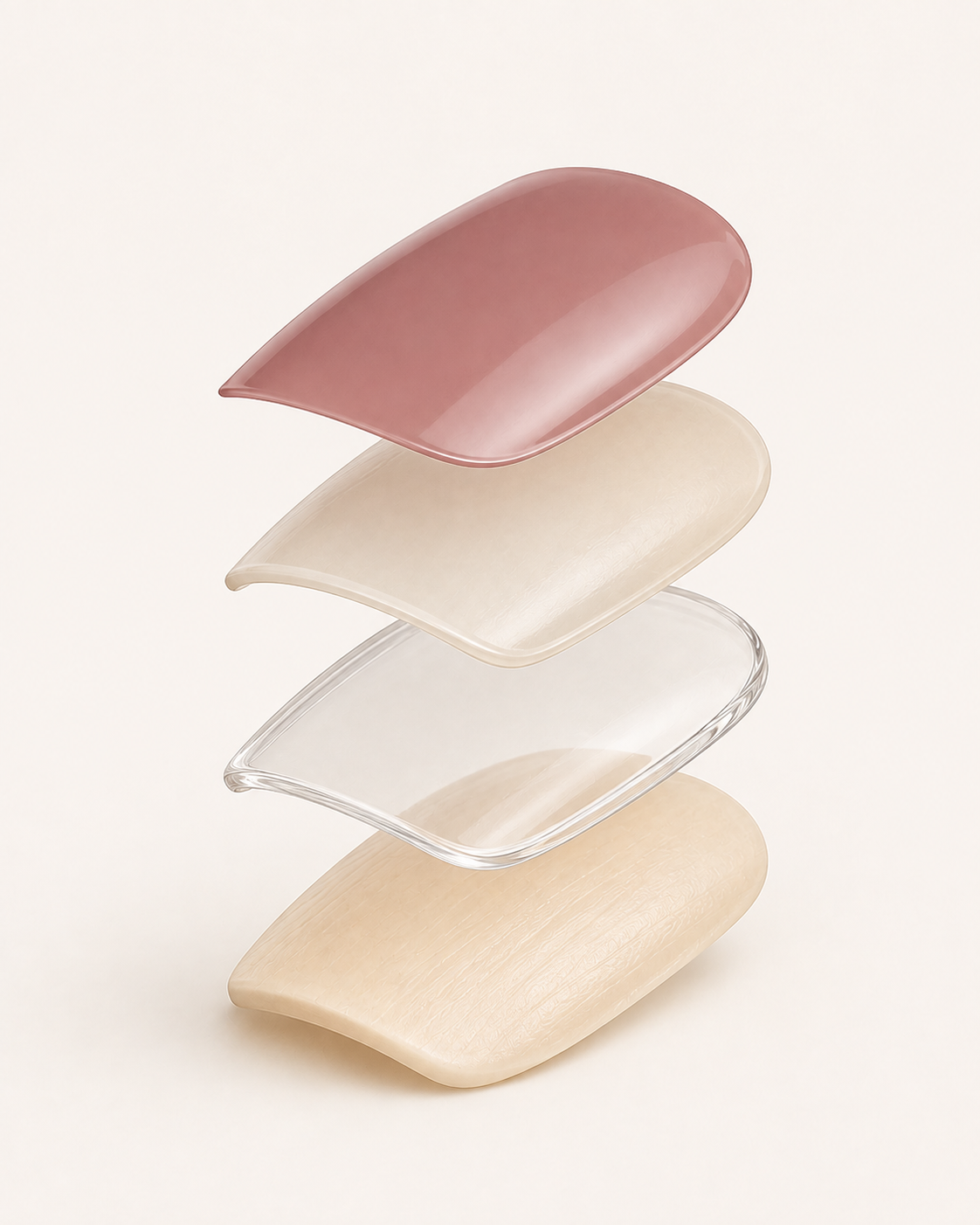
| Layer | Material or role | What it means for you |
|---|---|---|
| Finish | HEMA-free, pre-cured gel | Colour and gloss arrive finished. |
| Base | PMMA acrylic, tapered at the root | Shape and support, with less cuticle-side bulk. |
| Attachment | Pressure-sensitive jelly tab | Hold and release without liquid nail glue. |
| Your nail | Clean, dry, intact natural nail | Fit and condition come before application. |
Sources: N1
01 / Understand the product
Two polymer families. Compare the same properties, then check the finished nail.
ABS means acrylonitrile butadiene styrene. PMMA means poly(methyl methacrylate), an acrylic polymer. Both are plastics; neither name alone specifies the grade, additives, thickness or coating of a finished nail. NAILINK specifies PMMA for its structural base, not for every layer of the product.
| Consideration | ABS | PMMA |
|---|---|---|
| Useful strengths | Impact tolerance and mouldability; glossy grades are available. | Optical clarity and surface hardness; modified grades vary. |
| Trade-off | A material name does not establish thinness, fit or finish quality. | Unmodified grades can be relatively rigid; a thinner design changes local flex. |
| Cost context | NAILINK describes its compared ABS sourcing option as lower cost; quotations are not published. | NAILINK reports a higher cost for its selected PMMA base; this is procurement context, not a market-wide rule. |
Cost is not a quality certificate. Grade, order volume, tooling, hand-finishing, inspection and adhesive all contribute to the finished price. There is no verified cost ratio or market-wide ABS-versus-PMMA price ranking in this guide.
PMMA is a polymer, not the same thing as free MMA monomer or a liquid-and-powder salon service. The material name does not prove that a finished product has no residual monomer. Removal should be compared by the actual attachment system, not by these two base names.
01 / Understand the product
A tip category is not a complete chemical formula or an application method.
Soft-gel tips are pre-formed nail tips described by their maker as made from soft gel. Aprés describes Gel-X tips as a soak-off soft-gel compound, but the cited product explanation does not disclose a complete formulation. Do not substitute a guessed ingredient list for that missing specification.
They can be part of an extension system, and some finished soft-gel sets are sold as press-ons. For example, Aprés calls its Liquid Death collection press-on nails while specifying Extend Gel and LED curing. The label alone therefore does not mean glue-free, lamp-free or reusable.
| Question | What to check | NAILINK EVERYDAY |
|---|---|---|
| What is the base? | The actual material specification, not just the word gel. | PMMA, with a thinner cuticle-side root. |
| Is the design finished? | Does colour or top coat still need to be applied? | Hand-finished, pre-cured gel colour and gloss. |
| How does it attach? | The exact adhesive, lamp and removal instructions. | Jelly tabs; no liquid nail glue or customer lamp. |
NAILINK is a gel-finished PMMA press-on system. The gel coating does not make the base a soft-gel tip, and the jelly tab is not a light-cured gel adhesive. Follow the instructions for the complete product you actually buy.
01 / Understand the product
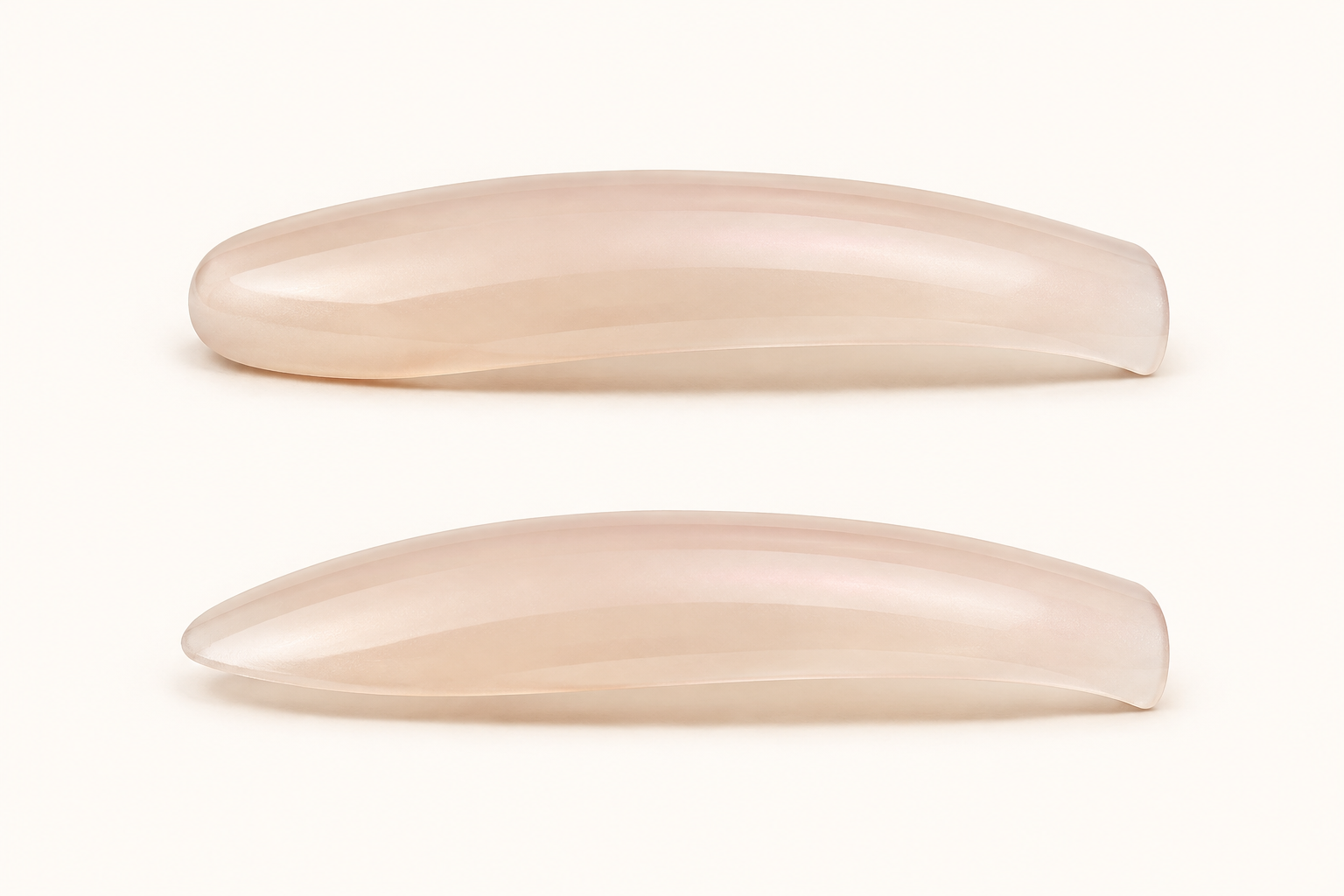
Less bulk at the cuticle. A curve that needs less forcing.
NAILINK specifies a thinner cuticle-side zone and a flatter profile informed by Australian customer fittings. The aim is a smoother visual transition and more local flex at the base. This is a design choice, not a claim that all Australian women have the same nail shape.
| Published property | ABS: NOVODUR H701 | PMMA: PLEXIGLAS GS cast sheet |
|---|---|---|
| Density / ISO 1183 | 1.04 g/cm³ | 1.19 g/cm³ |
| Tensile modulus / ISO 527 family | 2,100 MPa | 3,300 MPa |
NOVODUR H701 is an industrial ABS injection-moulding grade; PLEXIGLAS GS is a cast PMMA sheet reference, not NAILINK's moulded nail grade. The ABS density is published as 1,040 kg/m³, equivalent to 1.04 g/cm³. These are not matched finished-nail tests.
Density describes mass per volume; tensile modulus describes resistance to stretching, not bending or perceived softness. Finished-nail weight and flex also depend on thickness and shape. The figures cannot establish that NAILINK is lighter, softer or more durable than a competitor.
02 / Choose your fit
Width first. Curve second. Then test your normal movements.
Dry-fit every finger before preparing or applying anything. A suitable piece covers the visible nail plate, rests evenly and stays off surrounding skin without pinching. A larger number range does not replace this physical check.
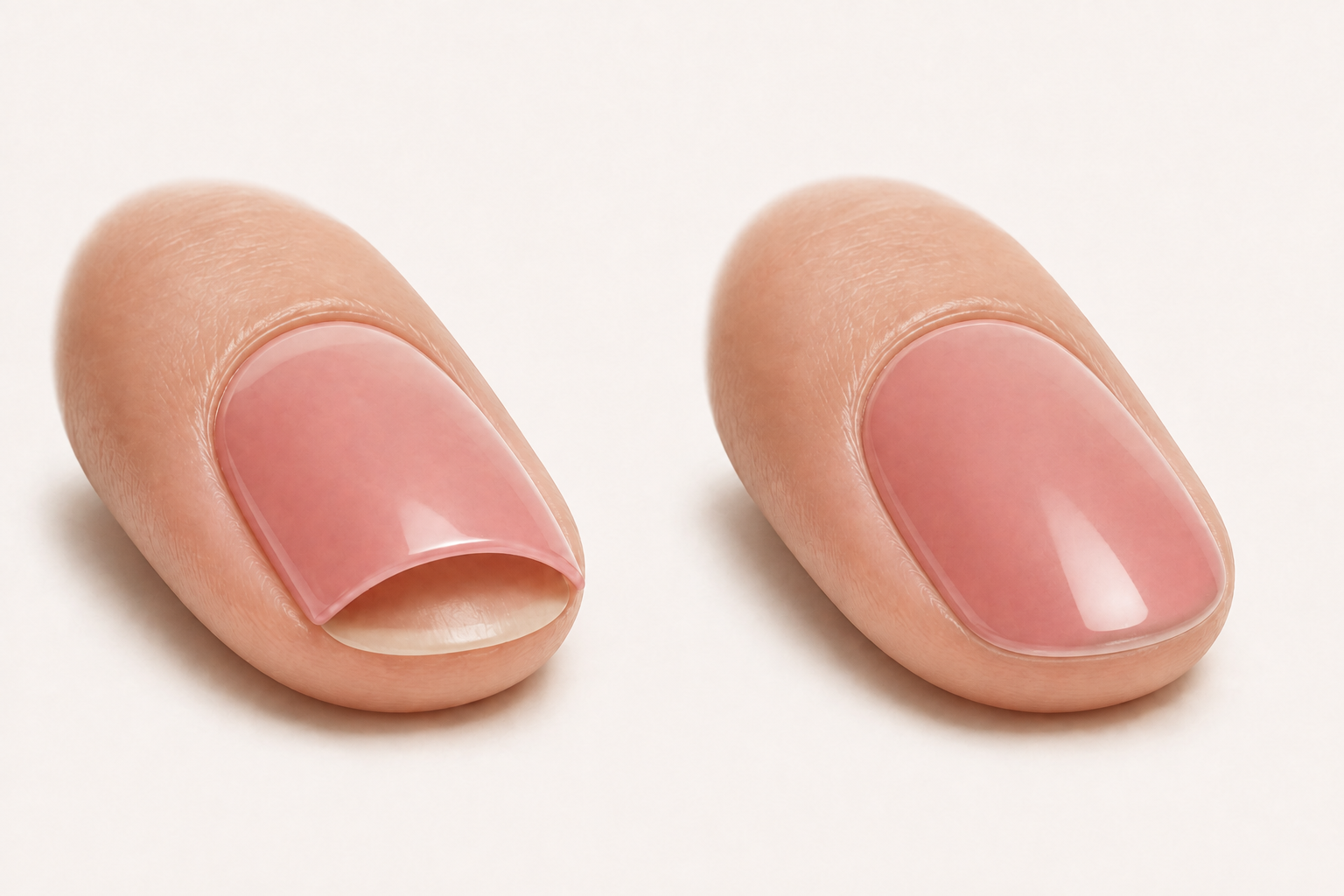
| Check | What to do |
|---|---|
| Width | Compare neighbouring sizes; do not force a narrow piece. |
| Curve | If it rocks or springs back, try another profile. |
| Length | Mimic typing, using your phone and fastening clothing. |
| Both hands | Record ten individual sizes; left and right can differ. |
EVERYDAY contains 24 nails in 12 sizes, two of each size. Shapes use different charts. Open the shape-specific sizing guide before ordering; if no piece rests comfortably, ask for fitting help instead of adding stronger adhesive.
02 / Choose your fit
Four shapes. Twelve sizes in each. Compare the measurements, then check the fit.
EVERYDAY offers Short Almond, Extra Short Oval, Short Oval and Short Square. Each box contains 24 nails in 12 sizes, two of each. Size numbers belong to a particular shape: the same number is not an identical fit across all four charts.
The ranges below summarise the length and width entries in NAILINK's published shape charts, checked on 7 September 2026. They describe the pieces, not Australian women's natural nails. They are not new physical measurements, and a minimum-to-maximum range does not mean every intermediate width is available.

Swipe the diagram to read all labels.
| EVERYDAY shape | Length range (mm) | Width range (mm) |
|---|---|---|
| Short Almond | 11-16.6 | 5-13.8 |
| Extra Short Oval | 17-21.5 | 7.6-14 |
| Short Oval | 14-20 | 6-13.2 |
| Short Square | 13-17.4 | 6.2-14 |
Use the length and width on the same size row. Shape names are not a cross-shape length ranking. If a dimension or measurement method is unclear, ask NAILINK before choosing.
Look for sidewall-to-sidewall coverage, no skin overlap and no pinching or rocking. Record the size and shape for each finger on both hands.
Test typing, phone use and fastening clothing before attaching. Choose the length that works for your routine, and check any workplace restrictions.
The existing charts also list Outer arc and Inner arc. Their measurement landmarks, method and tolerances have not been independently verified for this guide. We do not convert those values into a curve radius, angle or population-fit percentage. A numerical width match is only a starting point; the piece must also rest comfortably on your nail.
03 / Understand the connection
Choose how you want to wear it - and how you want to take it off.
A jelly tab is a pre-formed adhesive film. Typical liquid nail glue is cyanoacrylate-based and bonds without a lamp. Gel adhesive is a different system that needs compatible light curing. Do not add glue to tabs or improvise a gel cure under an opaque finished press-on.
| Decision | Jelly tabs | Liquid nail glue | Light-cured gel adhesive |
|---|---|---|---|
| Application | Pressure on a clean, dry surface. | Controlled liquid dose; no lamp. | Compatible product, tip and lamp. |
| Style changes | Removable connection suits changing sets. | Removal can need a dedicated remover. | More involved removal commitment. |
| Removal | Follow tab instructions; release slowly. | Follow that glue's remover directions. | Product-specific soak-off or file-off. |
| Supplies to budget for | Fresh tabs for each new application. | Glue plus any specified remover. | Set-up: compatible lamp. Ongoing: adhesive and removal supplies. |
NAILINK uses high-durability jelly tabs exclusively for customer attachment. They are selected for secure everyday hold and convenient style changes. Fit, preparation and hand use affect wear; there is no fixed day count or head-to-head longevity result in this guide.
03 / Understand the connection
A pressure-sensitive connection, with a named composition record.
The supplier MSDS for the submitted jelly-tab sample lists 90% acrylates copolymer and 10% PET by weight. This is a composition declaration, not an independent quantitative assay. Acrylates copolymer is the adhesive polymer; PET is a polyester in the reported composition. The document does not identify PET's precise position within the tab.

Swipe the diagram to read all labels.
The sample declaration does not by itself verify every retail batch, guarantee a wear time or establish irritation-free use. A traceable batch specification and measured wear results would answer different questions.
03 / Understand the connection
The gel finish is completed before it reaches your hands.
NAILINK specifies a HEMA-free gel colour and finishing system, cured before sale. This is the brand's finish specification, not a HEMA assay reported in this guide. It does not mean the entire product is free of all acrylate chemistry. PMMA remains the structural base, and the jelly tab is a separate adhesive.
Gel polish commonly uses reactive resins or monomers and light-initiated chemistry to form a cured coating; pigments and additives vary. NAILINK does not publish a complete gel formulation, so this guide does not invent a full ingredient list.

Swipe the diagram to read all labels.
HEMA is a sensitising monomer. The SCCS identifies skin contact and incorrect application as relevant concerns. Removing one ingredient does not establish allergy-free use. If you have a diagnosed acrylate or nail-product allergy, obtain ingredient-specific advice before using an unfamiliar system.
03 / Understand the connection
NAILINK application has no nail-lamp step.
Yes. UV and many LED nail-curing devices emit ultraviolet radiation. Exposure depends on the device and use. A 2021 ARPANSA/QUT report found low risk at the required drying times for eight tested devices. It did not measure cumulative lifetime exposure and is not proof of zero risk for every device or user.
The American Academy of Dermatology advises UV protection for gel manicures, such as broad-spectrum SPF 30+ sunscreen or dark, opaque fingerless gloves. People with photosensitivity or relevant medical concerns should seek individual advice.
| Routine | Customer lamp | Important distinction |
|---|---|---|
| NAILINK + jelly tabs | Not required | The decorative finish arrives pre-cured. |
| UV/LED gel manicure | Required | Use the product's compatible cure system. |
| Liquid-and-powder acrylic | Not inherently required | The acrylic sets chemically; a gel top coat may add lamp use. |
NAILINK's benefit is specific: you do not expose your hands to a nail-curing lamp when applying the finished set. It is not a claim that one correctly performed gel manicure necessarily causes observable skin damage.
04 / Wear, release, repeat
Good contact starts before the first press.
Use the instructions supplied with your set. Start with healthy, intact nails. Do not apply over pain, redness, swelling, discolouration, broken skin or a lifting natural nail.
Dry-fit and arrange the pieces in finger order. Set aside any that pinch or rock.
Clean your hands and nails, then let them dry fully before attachment.
Use the supplied alcohol prep pad as directed. Let it evaporate; avoid touching the cleaned nail.
Keep it inside the nail boundary. Smooth out air and folds; do not stack tabs.
Position close to, not on, the cuticle. Press firmly and evenly for 30 seconds.
Confirm no skin overlap or exposed adhesive. Avoid water, oil and heavy hand use immediately afterwards.
If you notice pain or irritation, stop. Do not cover the problem with another layer. A pressure-free fit matters more than making a poor fit stay attached.
04 / Wear, release, repeat
The symptom tells you where to look first.
These are possible causes, not a diagnosis or a ranking of how often problems occur. Inspect a loose piece rather than pushing water or debris back under it.
| What you notice | Check first | What to do |
|---|---|---|
| One nail keeps coming off | That finger's width, curve and tab coverage. | Refit that finger; use a fresh tab. |
| Several nails lift early | Oil, moisture, folds or incomplete pressure. | Restart on clean, fully dry surfaces. |
| Hair catches at the base | Early lift, skin overlap or an exposed tab. | Remove, inspect and reapply if sound. |
| The nail slides | Tab size, films, trapped air or surface oil. | Replace the tab; do not stack layers. |
| Immediate pinching | Width or curve pressing against the nail. | Remove without force; change the fit. |
| Redness, itching or pain | Possible irritation or a nail problem. | Stop use; seek advice if persistent or concerning. |
Normal handwashing is still important. Repeated soaking, pools, oils and demanding hand use can affect attachment. Inspect edges afterwards. High durability is not a waterproof or activity-proof guarantee.
04 / Wear, release, repeat
Let the bond release. Never make your natural nail take the force.
The instructed NAILINK jelly-tab routine needs no liquid-glue remover, drill, aggressive scraping or acetone soak. Follow the current care directions and allow more time whenever the connection resists.
Use warm, not hot, soapy water and oil as directed. Let the release process begin.
Work gently only where the connection gives. Do not insert a tool to lever off a firmly attached nail.
Add time and repeat the softening step. Never peel, twist or pull through resistance.
Remove loose tab residue gently. Reuse only clean, intact, unwarped pieces with sound edges and finish.
Use a fresh tab for every new application. Keep sound pieces dry in a clean case. Retire a cracked, peeling, sharp or contaminated piece; there is no guaranteed reuse count.
Forced removal can damage a natural nail with any attachment system. Gentle release is the design intention, not an unconditional no-damage promise. Leave a sore or damaged nail uncovered and seek appropriate advice.
04 / Wear, release, repeat
Press On. Be Free. A manicure that works around your plans.
NAILINK is designed for women who want a considered finish without scheduling a fresh salon application for every style change. Short and extra-short options keep the look practical, while the jelly-tab routine lets you plan both the wear and the removal.
| Your priority | Why it may suit you | Plan for |
|---|---|---|
| Work and everyday tasks | Short lengths; less cuticle-side bulk. | Dry-fit first and test your usual movements. |
| Travel and occasions | Finished sets and fresh tabs pack together. | Pack a care kit; water and activity affect wear. |
| Changing your look | No customer lamp or liquid-glue step. | Allow unforced removal time between sets. |
It may not suit every situation: a known nail-product allergy, unhealthy nails, a profile that does not fit, or a workplace that prohibits artificial nails. For constant soaking or demanding manual work, be realistic about maintenance rather than choosing on a wear-day promise.
Compare value by what you receive, how comfortably it fits and whether you can reuse sound pieces. A lower headline price is not automatically cheaper per successful wear, and reuse savings should not be calculated from an untested repeat count.
Sources: N1
05 / Check the evidence
Product specifications, sample documents and research answer different questions.
NAILINK separates what it specifies about its product from what an external organisation has studied. A supplier safety document is useful, but it is not an independent clinical trial of this finished manicure.
| Statement | Basis | What remains outside that evidence |
|---|---|---|
| PMMA; tapered root; flatter curve | NAILINK product specification. | No published comparative weight, thickness or flex test. |
| HEMA-free, pre-cured gel finish | NAILINK finish specification. | No HEMA assay supplied here; not proof of zero residual monomers or allergy-free use. |
| Jelly-tab 90% / 10% composition | Composition declaration in MSDS HPT260022605ME, section 3.2. | No quantitative assay reported; does not verify every retail batch. |
| High-durability jelly tabs | NAILINK's selected attachment specification. | No universal wear-day count or superiority test. |
| No customer lamp or liquid glue | The stated application process. | Not a whole-product medical safety certification. |
Additional nail-tip and gel documents are held on file. For example, the YJ-R-202505-1429 gel report covers specified metals and microbiology, not HEMA. A result reported as not detected refers to the stated method and detection limit; it is not a universal zero-content claim. These records do not establish full ingredients, fit or clinical outcomes, and should not be extended to unmapped colours or batches.
Need to check a material or sensitivity concern before buying? Contact support@nailink.store with the product name and your specific question. Ask for the relevant specification or document scope.
Frequently asked questions
No. NAILINK's finished nails use high-durability jelly tabs. The gel finish arrives pre-cured, so you do not apply liquid nail glue or cure wet gel on your hands.
Not necessarily. Soft-gel tips describes a pre-formed tip category, not one complete formula or attachment method. Some are used for extensions; some finished sets are sold as press-ons and still specify gel adhesive and a lamp. NAILINK instead uses a PMMA base, pre-cured gel finish and jelly tabs.
No. PMMA is a polymer; MMA is a monomer. A pre-formed PMMA nail is not the same product or process as a liquid-and-powder salon enhancement. The polymer name alone does not establish the residual-monomer content of a finished product.
Not automatically. Material grade, thickness, curve and coating all matter. NAILINK uses PMMA with a thinner root zone and flatter profile; this is a finished-design choice, not proof that PMMA is inherently softer or lighter.
There is no one day count for every wearer. Fit, clean and dry preparation, water, oil and activity affect the result. Inspect lifting early and reapply with a fresh tab only if the nail and press-on are sound.
HEMA-free is not allergy-free. NAILINK's claim applies to its gel finishing system, while the base and tab are separate materials. If you have a diagnosed allergy, seek ingredient-specific advice before use.
Use the instructed release process and never force a resisting piece. NAILINK's tab routine avoids drilling, aggressive scraping and acetone soaking, but poor fit or forced removal can still cause damage.
Keep normal hand hygiene. Water, soaking, soap, oil and repeated hand use can affect wear. Inspect the edges and remove a loose piece rather than trapping moisture underneath.
Check that finger's width, curve and tab coverage. A neighbouring size or different profile may fit better. Stronger adhesive cannot correct a piece that rocks or presses into skin.
Look for a lifting base edge, adhesive outside the nail outline or overlap onto skin. Remove and inspect the affected piece; do not keep pressing debris into the gap.
Yes, if each removed piece is clean, intact and still fits, with a sound finish and no sharp edge. Use fresh tabs. Retire cracked, warped or contaminated pieces; no fixed reuse count is promised.
24 nails in 12 sizes, one 30-tab adhesive sheet, two 75% alcohol prep pads, a mini nail file and a crystal cuticle stick. Check the current product listing for the set you choose.
Short or extra-short profiles can reduce free-edge leverage, but width and curve must fit too. Test typing and phone use during dry fitting; pack a small care kit for trips.
Do not mix attachment systems. NAILINK's routine uses one fresh jelly tab per nail. Mixing glue and tabs can make contact and removal unpredictable.
Continue learning